

Tooth extraction in Milton at White Dove Dental may be recommended when a tooth cannot be saved due to severe decay, damage, infection, advanced gum disease, or orthodontic or restorative planning. The decision is based on clinical examination and imaging, with local numbing used, comfort monitored, and aftercare instructions provided.
Tooth Extraction at White Dove Dental
- Definition: Tooth extraction means carefully removing a tooth that cannot be biologically saved.
- When It Is Needed: It may be recommended for severe decay, damage, active infection, advanced gum disease, or required orthodontic/restorative planning.
- Accurate Diagnosis: The decision is based exclusively on a clinical examination and diagnostic imaging.
- The Procedure: The tooth is carefully loosened and removed by the dentist.
- Patient Comfort: Local numbing is expertly used to minimize discomfort. Most patients feel pressure, not pain, during the extraction.
- Complexity: The difference between a simple vs surgical extraction is clearly explained when relevant.
- Expected Recovery: Mild to moderate soreness is expected afterward. Swelling or tenderness may occur temporarily.
- Healing Timeline: Initial healing begins within 3-10 days.
- The "Zero Assumption" Approach to Cost: Typical tooth extraction cost is $200-$300 per tooth. Costs vary based on complexity, and tooth replacement options are explained when needed.
If you are searching for tooth extraction near you, comparing tooth extraction cost, or worried about tooth extraction pain, White Dove Dental can help you securely understand your options. Your dentist will examine the tooth, review imaging when needed, explain whether extraction is appropriate, and rigorously discuss comfort, cost, aftercare, and your next steps before treatment begins.
What Is Tooth Extraction?
Understanding the tooth extraction meaning is the first step toward relieving dental anxiety. A tooth extraction, commonly referred to as dental extraction or tooth removal, is the clinical removal of a tooth that cannot be saved or needs to be removed for the sake of your overall oral health.
This procedure is never recommended without a thorough dental exam. The decision is based entirely on clinical examination and imaging. Depending on the tooth's anatomy, an extraction may be simple or surgical. Once the infected tooth or damaged tooth is removed, your dentist may discuss tooth replacement options to restore your complete smile.
When Is Tooth Extraction Recommended?
Tooth extraction may be highly recommended when a tooth simply cannot be saved, or when its removal is critical for other clinical planning.
White Dove Dental's clinical file confirms extraction may be recommended for:
- Severe decay: When a cavity has destroyed too much tooth structure to support a filling or crown.
- Severe tooth damage: A deep fracture or trauma that cannot be repaired.
- Infection: A severe dental infection that cannot be cured with root canal treatment.
- Advanced gum disease: Severe periodontal disease that has permanently destroyed the supporting jawbone.
- Orthodontic planning: Removing teeth to safely create space for braces or clear aligners.
- Restorative planning: Required preparation for a full arch of implants or dentures.
The dentist will always explain whether the tooth can be preserved with a tooth filling, root canal treatment, or crowns and bridges before ever recommending removal.
Which Teeth Cannot Be Pulled?
Patients frequently ask if there are teeth that cannot be pulled. While most teeth can be safely evaluated for extraction, some cases are anatomically complex. Teeth with severely curved roots, teeth impacted deep in the jawbone, or teeth located near major nerves may require advanced surgical planning, specialized imaging, a dental sedation discussion, or a specialist referral.
Your clinical examination and imaging determine the safest approach. Wisdom tooth extraction may also require a separate, highly specific assessment.
What Happens During the Tooth Extraction Procedure?
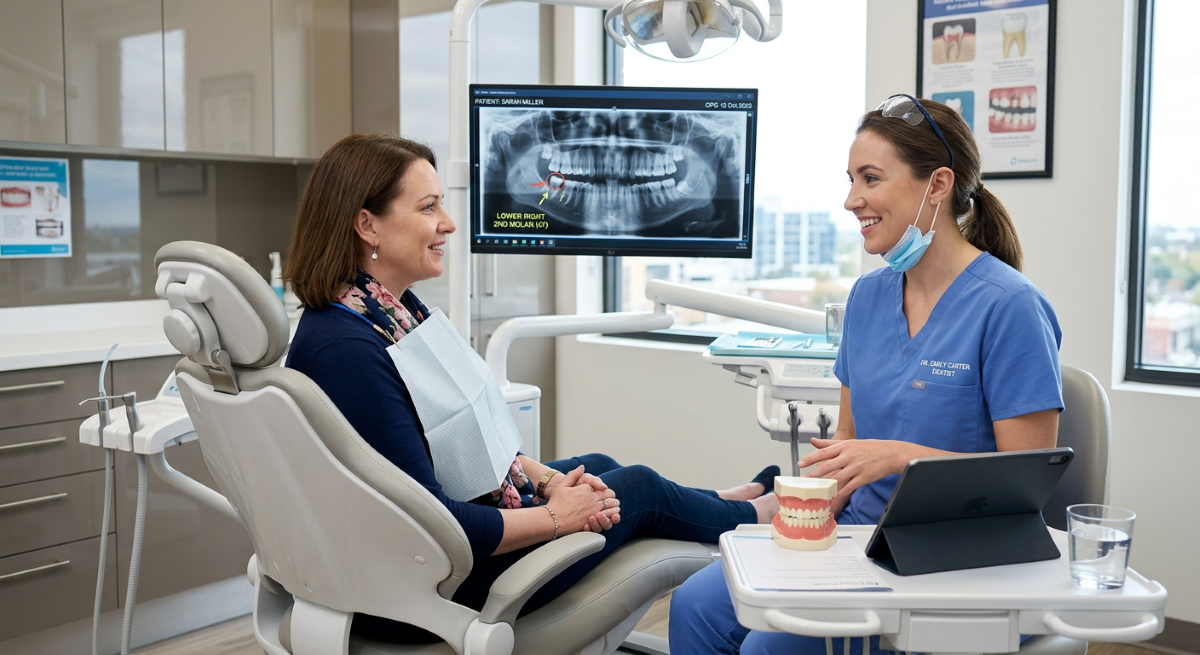
Knowing exactly what to expect during the tooth extraction procedure helps reduce anxiety. During the visit, the dentist carefully loosens and removes the tooth, uses local numbing to minimize discomfort, explains the difference between a simple extraction and a surgical extraction, and monitors your comfort throughout.
The Step-by-Step Process:
- Dental examination and imaging: The dentist confirms definitively whether extraction is needed.
- Treatment explanation: The exact procedure details are explained to you before treatment begins.
- Comfort planning: Strong local numbing is expertly used to minimize discomfort.
- Simple vs surgical discussion: The dentist explains whether the tooth requires a simple removal or surgical access.
- Tooth loosening and removal: The tooth is carefully loosened and safely removed from the socket.
- Comfort monitoring: Patient comfort is continuously monitored throughout the procedure.
- Post-operative instructions: Detailed instructions are provided for eating, rinsing, activity, smoking, and healing.
Is Tooth Extraction Painful?
When researching tooth extraction pain or asking, "Is tooth extraction painful?", many patients are surprised to learn that most patients feel pressure, not pain, during the extraction because effective local numbing is used.
Pain experience depends on the tooth location, anatomical complexity, infection severity, biological inflammation, and your individual sensitivity. White Dove Dental monitors your comfort throughout the entire visit. Mild to moderate soreness is absolutely expected afterward as the numbing wears off, and clear pain management guidance is provided to keep you comfortable at home.
What Side Effects Are Normal After Tooth Extraction?
Understanding normal tooth extraction side effects ensures a confident recovery. Following your dental extraction, mild to moderate soreness, temporary facial or gum swelling, and localized tenderness may occur.
These symptoms typically improve steadily within a few days. If symptoms worsen aggressively, feel highly unusual, or do not follow the tooth extraction recovery guidance provided, patients should contact White Dove Dental immediately for an evaluation.
What Is the Tooth Extraction Healing Time?
Patients are always eager to know the tooth extraction healing time. Initial healing after a tooth extraction begins within 3 to 10 days.
However, full internal bone recovery varies based on the extraction's complexity, the tooth location, your systemic medical factors, and exactly how closely you follow the provided aftercare instructions. You will receive detailed guidance on when to resume normal brushing, eating, and physical activity.
Why Can Day 3 Feel Worse After Tooth Extraction?
Patients occasionally research why day 3 feels uncomfortable. White Dove Dental explicitly explains that day-three discomfort is a recognized part of normal healing for some patients. Inflammation often peaks around the third day before it begins to subside. Symptoms typically improve within a few days. We advise patients to follow their pain management guidance and contact the clinic only if symptoms worsen instead of naturally improving.
Tooth Extraction Aftercare: What Should You Do and Avoid?
Excellent tooth extraction aftercare is the key to preventing complications. White Dove Dental provides strict instructions on what to do and what things to avoid after tooth extraction.
- Eating: Explicit instructions are provided on eating safely after extraction to avoid disturbing the extraction site.
- Rinsing: Safe rinsing instructions are provided to keep the site clean without dislodging the blood clot.
- Activity: Activity instructions are provided; rest is prioritized.
- Smoking: Smoking is fiercely discouraged during healing, as it severely delays recovery and increases complication risks.
- Strenuous activity: Heavy lifting and strenuous activity are strongly discouraged during the initial healing phase.
- Pain management: Clear guidance on managing mild to moderate soreness is provided.
- Follow-up: Contact the clinic if symptoms worsen or feel unusual.
How Long After Tooth Extraction Can I Eat?
Patients frequently ask, "How long after tooth extraction can I eat?" or "How long after tooth extraction can I eat on that side?"
Because every procedure is different, you must follow the precise eating instructions provided by the clinic after your treatment. Timing depends heavily on your specific procedure, how long the numbing lasts (to prevent biting your lip or tongue), your comfort level, and your healing progress.
Should I Take a Day Off Work After Tooth Extraction?
Whether you need time off depends entirely on the extraction complexity, your comfort level, post-operative swelling, whether dental sedation was utilized, and your specific job duties. Patients with physically demanding work may need different activity guidance than patients with desk work. White Dove Dental provides highly personalized activity instructions after treatment.
What Are Red Flags After Tooth Extraction?
Contact White Dove Dental immediately if your pain aggressively worsens instead of improving, if swelling increases rapidly after the first few days, if uncontrolled bleeding concerns occur, or if your symptoms feel highly unusual compared with the aftercare instructions provided.
How Much Does Tooth Extraction Cost in Milton?
Understanding the tooth extraction cost (or tooth extraction price) helps patients plan their care confidently.
Tooth Extraction Cost Guidance at White Dove Dental:
- Typical tooth extraction cost: $200 to $300 per tooth.
- Complexity: More complex cases (like severely broken teeth) may slightly affect the cost.
- Tooth location: The cost naturally varies based on the tooth location and root anatomy.
- Simple vs surgical extraction: The clinical approach is explained when relevant, which dictates the fee.
- Insurance: Coverage is strictly reviewed when applicable.
- Before treatment: All out-of-pocket costs are transparently discussed before any treatment begins.
- Replacement planning: Tooth replacement options are explained when needed, which may factor into your long-term budget.
Is Tooth Extraction Covered by Insurance or CDCP?
Insurance coverage for a tooth removal is thoroughly reviewed when applicable, and costs are explicitly discussed before treatment begins. If you are part of the Canadian Dental Care Plan (CDCP), please note that White Dove Dental proudly accepts CDCP patients. Coverage depends strictly on eligibility, plan limits, and program approval. Some services may be fully or partially covered, and patients may pay non-covered portions.
What Happens After a Tooth Is Removed?
After an extraction, White Dove Dental provides detailed aftercare instructions and thoroughly explains your tooth replacement options when clinically needed. Leaving a gap in your smile can cause surrounding teeth to shift and affect your bite.
Common Replacement Options:
- Dental implants
- Crowns and bridges
- Dentures
- Full mouth rehabilitation (if multiple teeth are missing)
Tooth Extraction vs Root Canal: Which Is Better?
A root canal treatment may help preserve a natural tooth when possible, while a tooth extraction removes a tooth that cannot be saved or needs removal for clinical planning. The "right" choice depends strictly on examination and imaging.
Tooth Extraction:
- Main purpose: Remove a tooth that cannot be saved or needs removal.
- When recommended: Severe decay, massive damage, untreatable infection, advanced gum disease, or orthodontic/restorative planning.
- Comfort: Local numbing used; most patients feel pressure, not pain.
- Recovery: Initial healing begins within 3-10 days.
- Cost guidance: $200-$300 per tooth.
- Long-term planning: Replacement options (like implants) may be highly recommended.
Root Canal Treatment:
- Main purpose: Treat infected or damaged pulp to gracefully preserve the tooth when possible.
- When recommended: Persistent pain, chewing pain, swelling, or lingering hot/cold sensitivity when the pulp is affected but the tooth is structurally sound.
- Comfort: Local numbing used; comfort closely monitored.
- Recovery: Mild soreness or sensitivity; symptoms typically improve within a few days.
- Cost guidance: $650-$1,100 per tooth.
- Long-term planning: A protective crown may be needed depending on remaining tooth structure.
Simple Tooth Extraction vs Surgical Tooth Extraction
The difference between a simple extraction and a surgical extraction is explained when relevant, depending entirely on tooth position, anatomical complexity, imaging findings, and clinical needs.
Simple Extraction:
- Tooth condition: Often more accessible and fully erupted above the gumline.
- Planning: Exam and imaging securely guide treatment.
- Comfort: Local numbing is expertly used.
- Complexity: Usually far less complex.
- Aftercare: Standard eating, rinsing, and activity instructions are provided.
Surgical Extraction:
- Tooth condition: May involve a complex position, challenging anatomy, broken roots, or an unerupted tooth.
- Planning: Exam and imaging are especially critical.
- Comfort: Local numbing is used; dental sedation may be actively discussed when appropriate.
- Complexity: Inherently more complex, requiring surgical access.
- Aftercare: Strict aftercare instructions provided; recovery timelines may vary.
Why Choose White Dove Dental for Tooth Extraction in Milton?
White Dove Dental provides expert tooth extraction in Milton with examination-based diagnosis, imaging when needed, highly effective local numbing, comfort monitoring, clear treatment explanations, detailed aftercare instructions, cost transparency, and replacement planning when needed.
- Located securely at 2-61 James Snow Parkway North, Milton, Ontario L9E 0H1.
- Tooth Extraction is a confirmed, high-priority oral surgery service.
- Wisdom Tooth Extraction and generalized Oral Surgery are also confirmed services.
- The decision to extract is based strictly on clinical examination and imaging.
- Local numbing is expertly used to minimize discomfort.
- Procedure details are thoroughly explained before treatment.
- Patient comfort is continuously monitored throughout.
- Clear pain management guidance is provided.
- The initial healing timeline is properly explained.
- Specific eating, rinsing, and activity instructions are provided.
- The cost range is fully discussed before treatment begins.
- Tooth replacement options are explained when needed.
FAQ About Tooth Extraction
Get Relief and a Clear Treatment Plan
If you are searching for tooth extraction near you, comparing the true tooth extraction cost, or deeply worried about tooth extraction pain, White Dove Dental can securely help you understand whether a tooth removal is the right next step. Your dentist will meticulously assess the tooth, review imaging when needed, explain viable alternatives, and transparently discuss aftercare before treatment begins.
Service-Specific Benefits:
- Comfort-focused care: Local numbing is utilized to minimize discomfort, and patient comfort is heavily monitored throughout the entire visit.
- Clear aftercare and next steps: You receive exact guidance on eating, rinsing, activity, healing, cost, and tooth replacement options when needed.
A painful, deeply infected, severely damaged, or non-restorable tooth should be clinically assessed immediately before symptoms aggressively worsen. Book a tooth extraction consultation at White Dove Dental in Milton to review your biological options, cost, comfort plan, aftercare instructions, and whether replacement planning is ultimately needed.